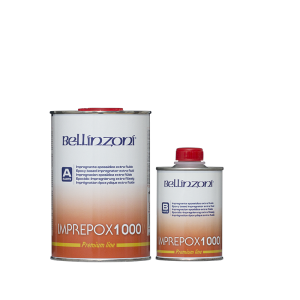
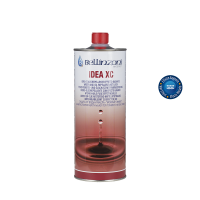
Method of use : ALWAYS TEST PRODUCT FIRST following the below indications, before proceeding with the complete product application. Ensure that surfaces to be treated are completely dry and clean, free of dirt, dust, grime and surface incrustations.
Manual application:
1. Thoroughly clean and dry surfaces to be repaired and filled
2. If colouring is required, mix BELLINZONI EPOBEL pigment directly into part A, up to a maximum weight of 5% in volume before mixing in part B.
3. Mix the two parts together in a container following the indicated ratio (4:1 volume or weight). For small jobs mix small amounts at a time in separate container. Mix thoroughly so to obtain a homogeneous mass.
4. Pour to surface and evenly distribute using a toothed trowel or rubber-based spatula. Allow product to penetrate all pores, holes and fissures completely before allowing surface to dry. Work on small areas per time.
Notes: For ideal working amounts, 150 /250 grams are sufficient. The mixture remains workable for approx. 20 - 30 minutes (20°C). After 24 hours (20°C) approx. they may be further processed and polished.
Industrial use: (slabs)
1. The stone slabs must be calibrated to their requirements and thoroughly cleaned before treatment. The surface must be dry and free from dust, dirt, oil and other contaminants.
2. For improved penetration, the slabs may be pre-heated before application. Pre-warming the substrate reduces the resin viscosity, allowing deeper penetration into pores, fissures and micro-cracks.
3. Thoroughly mix 4 parts of Part A with 1 part of Part B until a completely homogeneous mixture is obtained.
4. If colouring is required, add BELLINZONI EPOBEL pigment directly to Part A before adding Part B. Do not exceed 5% pigment by weight.
5. Apply the mixed resin uniformly over the slab using a roller or a fine-toothed rubber spreader, ensuring complete filling of pores, cavities, fissures and other natural imperfections. Open cracks should be sealed before application to prevent resin loss through the slab.
6. The mixed resin remains workable for approximately 20–30 minutes at 20°C.
7. Allow the resin to cure completely before further processing. Under normal conditions (20°C), the slabs may be ground and polished after approximately 24 hours.
8. During grinding and polishing, the contact pressure of the abrasive heads should not exceed 1.0–1.5 bar.
9. Clean all tools and application equipment immediately after use with acetone, before the resin has cured.
10. Curing is accelerated by higher temperatures and slowed by lower temperatures.
Application with Stone Reinforcement Meshr.
1. Apply a uniform coat of resin over the entire slab surface. Position the reinforcement mesh onto the wet resin and use a roller or spreader to ensure complete impregnation of the mesh and uniform adhesion to the substrate.
2. Where necessary, apply a second coat of resin to fully encapsulate the reinforcement.
3. Allow the resin to cure completely before moving or processing the slab.
Notes and advantages Crystal-clear, colourless formulation. Minimal shrinkage during curing. Excellent resistance to alkaline substances, making it particularly suitable for bonding concrete and cement-based materials. Recommended for bonding solvent-sensitive materials, as the product is solvent-free. Low VOC formulation, compliant with applicable European regulations. Excellent laminating properties, ideal for sandwich panel and stone lamination applications. Store the product in its original, tightly closed container.
 IT
 EN
 FR
 DE
 ES
 PT